
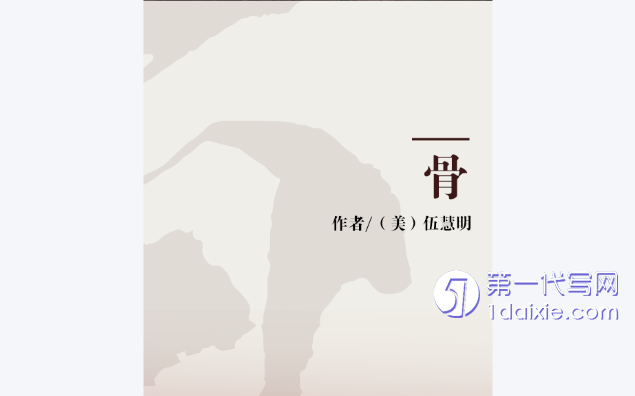
本文是一篇英语毕业论文,本论文旨在丰富物论和新物质主义文学研究领域的实践,阐明物质客体在人类主体性构建中的核心地位,以及文学在揭示我们与物质世界复杂关系网络中的独特力量。
Chapter One: Identity Construction Through and Identification with Objects
1.1 Papers and Bones: Mirror of Leon’s Psyche as a “Paper Son”
Leon Leong embodies the fractured identity of the “paper son”, a Chinese immigrant who purchased a fraudulent identity to enter the United States during the era of the Chinese Exclusion Act (1882). As a “paper son,” Leon’s existence hangs on a legal fiction: his fabricated identity papers that both validate his presence in America and trap him in institutional objectification. These documents started as survival tools but grow into existential burdens that haunt him, reflecting the broader trauma of Chinese immigrants who were forced to commodify their identities to navigate discriminatory laws. Alongside these papers, Grandpa Leong’s bones, remains that Leon fails to repatriate, serve as another material anchor for his identity, symbolizing his unresolved guilt and broken connection to his Chinese heritage.
Leon’s “paper son” documents represent a pivotal material anchor for his identity formation, exemplifying Bill Brown’s concept of object-thing transition. These documents trace a profound trajectory from utilitarian legal instruments to existential artifacts that fundamentally shape Leon’s sense of self. Initially, they functioned as pragmatic tools within a system designed to circumvent America’s exclusionary immigration policies. As Erika Lee explains in At America’s Gates, “this ‘paper son’ system was a common strategy that had evolved among the Chinese in response to the restrictive parameters of the exclusion laws” (Lee 18). For Leon, these fabricated identity papers represented both an escape from China and entry into America and a gateway purchased at considerable cost: “Five thousand American dollars” (Ng 50), a sum he recounts with perpetual astonishment throughout his life. As critic Lisa Lowe points out, the papers are at once “the ‘conversion’ of Chinese into ‘Americans’” (125) and a loss of history.
1.2 Collection and Invention: Model for Selfhood and Identity Construction
While Leon’s entanglement with his papers and Grandpa Leong’s bones reveals the material foundations of his fractured identity, his broader practices of collecting and reinventing objects demonstrate a more active strategy of selfhood construction through material engagement. Moving beyond the official documents that legally define him and the ancestral remains that haunt him, Leon creates a material ecosystem that extends and articulates his sense of self. His systematic hoarding of seemingly worthless items and his inventive transformation of discarded things constitute a deliberate response to his marginalization—a material assertion of presence and value in a society that renders him peripheral. These collections and inventions exemplify “object-thingness” in a different way than his papers and bones; rather than objects transforming into things through failure or resistance, these collected items become things through accumulation and reconfiguration, gradually shifting from utilitarian objects to identity-constituting artifacts that actively shape Leon’s understanding of himself and his place in the world.
Leon’s systematic collection of seemingly mundane objects constitutes what might be called a “material autobiography”—an articulation of selfhood through accumulated objects rather than written narrative. Brown’s observation that objects can “crystallize events, relations, situations” (A Sense of Things 171) illuminates how Leon’s carefully preserved items function as tangible records of his American experience, each object containing a fragment of his life story. Unlike traditional autobiography, which requires linguistic mastery Leon lacks, this material autobiography allows him to preserve his experiences through the physical artifacts of his daily existence.
Chapter Two: Memory and Emotion Resonant in Objects
2.1 The Sewing Machine: Carrier of Meaning and Mediator of Relations
In Bone, the Singer sewing machine emerges as one of the novel’s most resonant manifestations of object-thingness, embodying what Bill Brown calls the transformation of an “object” into a “thing”—something that exceeds its utilitarian function to assert its own significance and agency. While primarily a physical artifact, the sewing machine demonstrates how object-thingness can simultaneously serve as a powerful conduit for memory and emotion. The omnipresence of this machine throughout the narrative underscores its central importance in the characters’ lives and relationships, functioning not merely as a tool but as an active participant in shaping family dynamics and preserving immigrant history.
The sewing machine’s significance begins in the early years of Mah’s life, when she was struggling with her absent first husband. It was a chance encounter with Tommie that introduced her to sewing:
[T]ommie just happened to be locking up his factory. He remembered her. The pretty woman with the absent husband. Tommie consoled her. He offered her a job, but she didn’t know anything about sewing, so Tommie taught her everything, from threading the machine to the secret seam that laid the interfacing flat, to how to lift the sewing foot and run a quick backstitch to secure the head of the zipper. (Ng 188)
2.2 Food and Scents: Materializer of Affinities and Affects
While the sewing machine represents object-thingness through its physical presence and agency, food and scents in Bone exemplify what I have defined as “sensory-thingness”—material experiences that function as powerful conduits for memory and emotion through their direct impact on characters’ bodies and consciousness. These sensory elements operate differently from mechanical artifacts like the sewing machine, as they create immediate physical connections that bypass intellectual processing to directly evoke memory and emotion. Through careful attention to these sensory elements, Ng demonstrates how “sensory-thingness” asserts its own kind of agency, not by “stopping working” in Brown’s sense, but by actively shaping emotional states, triggering involuntary memories, and creating material links across time and space that characters cannot fully control.
2.2.1 Food and Cultural Aromas as Repositories of Memory and History
Oranges emerge as particularly significant carriers of cultural memory throughout the novel, functioning simultaneously as everyday objects and ritual artifacts that connect the present to tradition. When Leila observes that “after they stuff oranges into my book bag, they ask their favors. Time is what they want” (Ng 17), she reveals how oranges operate as a form of social currency that materializes obligations and relationships within the Chinese American community. The exchange of oranges for favors demonstrates that the fruit transforms from nutritional object to social medium. This transformation extends to ritual contexts when Leon purchases oranges labeled “GOLD COINS” (Ng 87) to place at Grandpa Leong’s grave.
Chapter Three: Materiality of the Literary Text.............................51
3.1 Structure as Embodiment of Memory: Form of Ancestral Ritual ......................52
3.2 Ocean as Medium of Movement: Materialization of Displacement ..................55
Conclusion .....................67
Chapter Three: Materiality of the Literary Text
3.1 Structure as Embodiment of Memory: Form of Ancestral Ritual
Bone’s non-chronological structure—its recursive movement backward and forward through time—functions as more than a narrative technique; it materializes what Ng describes as the immigrant orientation toward the past that shaped her own understanding of Chinese American experience. As Ng explains:
[T]he moving backwards structure comes from life. I grew up among the Chinese bachelor society, a generation of old timers who, because of a whole series of conditions—exclusion and miscegenation laws, revolutions in China—came to this country to work and ended up not being able to return home. I kept hearing these phrases: “When we go back home,” and, “Things were better back there.” I wanted to know, what was back there and I wanted to know where home was. (Ng, “Interview on Bone”)
The Chinese immigrants’ constant refrain of “When we go back home” and “Things were better back there” becomes physically embodied in the novel’s temporal movements, transforming an abstract cultural orientation into a tangible reading experience.
Conclusion
This thesis has explored the vital role that objects play in Fae Myenne Ng’s novel Bone, revealing how different forms of materiality actively participate in the construction of identity, the preservation of memory, and the embodiment of narrative. By employing the theoretical framework of thing theory and developing a three-part typology of “thingness,” this study has moved beyond treating objects as mere symbols to recognize them as agential forces that shape human experience in profound ways.
The typology of thingness developed in this study—object-thingness, sensory-thingness, and textual-thingness—has provided a framework for understanding how materiality operates across multiple dimensions in Ng’s novel. Each category illuminates different aspects of the Chinese American immigrant experience while maintaining conceptual precision about the various ways “thingness” manifests in the text.
The analysis of object-thingness in Chapter One demonstrated how physical artifacts like Leon’s “paper son” documents and Grandpa Leong’s bones transform from utilitarian items into existential entities with agency. These objects exemplify Brown’s classic definition of thingness as they “stop working for us” and begin to assert their own significance, becoming active participants in Leon’s identity formation. Rather than merely symbolizing his fractured sense of self, these objects actively constitute it, blurring the boundary between person and thing in ways that reflect the precarious status of Chinese immigrants in American society.
reference(omitted)